Custom Motifs
Customers can use their own design or work together with our team to develop a motif that fits their needs.
Production
From initial ideas to finished batik fabric, every production stage is handled with precision, experience, and quality standards.
Process Videos
See how every sheet of batik fabric is crafted at the Batik Soehadi atelier — from hand-drawn batik to digital printing.
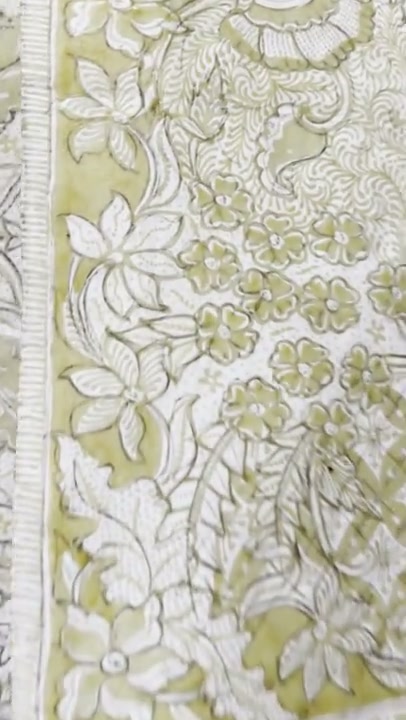
Hand-applied hot wax canting on primissima cotton
The pinnacle of Javanese textile heritage. Every curve and detail is hand-drawn directly onto fine cloth using traditional copper canting and molten botanical wax, creating bespoke heirlooms of unparalleled depth.
Characteristics & Strengths
Why Batik Soehadi
Customers can use their own design or work together with our team to develop a motif that fits their needs.
A fabric sample is made before mass production to ensure the motif and colors match the approval.
Every production stage follows a clear workflow, from motif preparation to finishing.
Every produced item is inspected before packing and shipping.
Services
Motifs are drawn directly onto the fabric using a canting tool and hot wax, producing unique designs tailored to your request.
View process →A copper stamp is used to press repeating motifs onto the fabric, creating patterns that are clean and consistent.
View process →Production using the screen-printing technique for large-scale orders, with an efficient process and controlled turnaround.
View process →A combination of printing and hand-drawn, or cap and hand-drawn, techniques — producing precise motifs with hand-finished detailing.
View process →Handprinting Batik
Here is our batik fabric production flow. Every stage is carried out sequentially to maintain quality from start to delivery.
The design can come from the customer. If customer designs are used, they will be re-prepared so they are ready to enter the production process.
Creating a visualisation of the design as if it were already a finished product, so customers can see an idea of the result.
Printing the design of each colour within a motif on plotter paper as preparation for the screen process.
The process of transferring the positive-negative design from the plotter output onto the screen. Each colour uses its own screen.
Refining the screen by opening the parts that ink will pass through during printing.
Making a fabric sample before mass production. The sample is used to ensure the motif and colours match the customer's approval.
Mass production of fabric using the prepared screens.
A drying or heating process to keep the printed ink from changing easily.
A colour-fixing process so the colours last longer.
The fabric is dried using the appropriate process to maintain production quality.
A soaking process to help lift any remaining colour residue.
Applying fabric softener so the cloth has a comfortable texture.
Final drying before the finishing process.
A finishing process that gives the fabric a neater, ready-to-use appearance.
Inspection of size, fabric quality, colour, and production results.
Products are packed neatly before delivery.
Products are delivered to the customer as required.
Ordering SOP
Production orders for handprinting batik follow the two methods below, depending on your needs and deadline.
DP / Down Payment
Up to 30 working days, depending on the production queue.
Priority
Faster turnaround and process. For time and cost estimates, contact us via WhatsApp.
Compare fabric options for your production on the price list.
See fabric price listHand-Drawn Batik
Hand-drawn batik is made entirely by hand using a canting tool and hot wax. Here are the stages from raw cloth to finished batik fabric.
The base cloth is washed, soaked, and beaten with a large mallet until the surface is flat and ready to receive wax.
The motif pattern is drawn onto the fabric with a pencil as a guide before the waxing process begins.
Hot wax is written directly onto the fabric using a canting - a pen-shaped copper tool with a fine spout. The artisan blows the tip to keep the wax flowing smoothly.
The fabric is dipped into a dye bath. Wax-covered areas do not absorb colour, forming a negative pattern.
The fabric is dried completely before moving to the next stage.
The wax is removed by scraping or boiling, revealing the contrast between the wax-protected and dyed areas.
The canting, dyeing, drying, and wax-removal stages are repeated for each additional colour desired.
Final drying, cleaning, and pressing until the fabric is ready for use.
Stamped Batik
Stamped batik uses a copper stamp to apply wax onto fabric. Here is the sequence from preparation to finishing.
The base cloth is placed on a flat table padded with soft material to even out pressure during stamping.
Wax is boiled until melted, with temperature maintained at 60–70°C for optimal consistency.
The canting cap - a copper stamp approximately 20 × 20 cm - is dipped into the liquid wax, about 2 cm of the bottom submerged.
The stamp is pressed onto the fabric with sufficient pressure. The liquid wax soaks through the fabric pores to the other side.
Different stamps are used alternately to build the desired motif combination on the fabric.
The fabric is dipped into a dye bath. Areas already saturated with wax will not change colour.
The fabric is boiled to remove wax residue, revealing two colours: the original fabric colour and the dyed colour.
If more colours are desired, the stamping, dyeing, and boiling process is repeated until the desired number of colours is reached.
A critical stage where colours from multiple dyeing cycles are blended. Requires specialised skill in colour selection and mixing.
Cleaning and brightening colours using soda, then drying and pressing until neat.
Combined Batik
Combined batik merges machine techniques (cap or printing) with hand-drawn touches (tulis) to produce motifs that are precise yet artistically unique.
The base cloth is prepared according to the base technique to be used - cap or printing - with initial washing and soaking.
The main motif is created using cap or screen printing, producing a precise and consistent base pattern across the fabric.
Areas of the fabric that will receive hand-drawn touches are identified - accents, fill patterns, or specific ornaments.
After the base technique is complete, specific details are added using a canting tool, giving the fabric a unique organic touch.
Special dyeing for the hand-drawn sections, creating colour contrasts or depth that cannot be achieved by machine alone.
All wax is removed from the fabric through boiling or scraping.
Cleaning, drying, and pressing - the fabric is ready with a combination of machine precision and unique hand-crafted artistry.
Fabrics
We offer a range of fabric options commonly used for batik, tailored to your production needs and budget. Cotton and other materials are also available.
Related Services
Explore the batik fabric we can produce for your needs.
Create batik fabric with motifs, colors, and materials that match your identity and needs.
Batik convection services for school, office, institution, and community uniforms.
Articles
The batik handprinting process in 17 steps, design, mockup, plotter, afdruk, screening, proofing, printing, through quality control and shipping.
How batik printing and batik cap differ in production, scale, motif character, and when to choose each, without absolute claims.
The stages of traditional tulis batik-making, from nyungging, nglowong, and isen-isen to melorod, and how it differs from handprinting production.
A comparison of the three main manual batik techniques, tulis, cap, and lukis, plus how they differ from batik-patterned textiles like printing and ecoprint.
Common Questions
Once the design and sample are approved, mass fabric production generally takes about 2-3 weeks. Hand-drawn and stamped batik take longer than handprinting because they are worked by hand piece by piece.
A minimum of 100 meters for fabric rolls and 50 pieces for ready-to-wear uniforms. For custom logo motifs we recommend starting from 200 meters so the screen preparation cost stays efficient.
Handprinting is manual screen printing on a 40-meter flatbed table, one screen per color, suited to large production with detailed motifs. Hand-drawn batik is worked with a canting by hand, so each piece is unique and takes longer.
Yes. We produce a strike-off proofing as a physical fabric sample so the color and motif are approved before mass production. Design revisions can still be made at this stage.
Every batch passes color and print-defect inspection plus a wash fastness test under SNI ISO 105-C06 scale 4 before packing.
Long-table handprinting, hot-wax copper stamp batik, batik printing, hand-drawn batik, and combinations of techniques to suit motif needs and order volume.
Share your design and production needs with our team — from custom motifs to mass production.